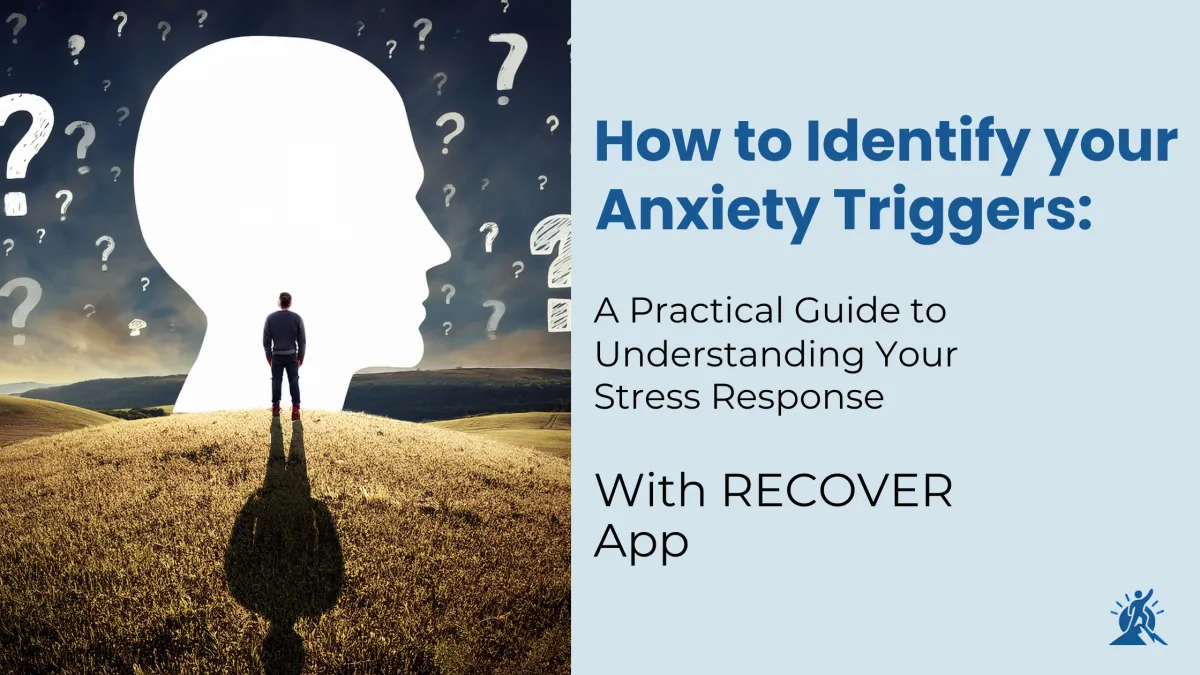
How to Identify Your Anxiety Triggers: A Practical Guide to Understanding Your Stress Response
How to Identify Your Anxiety Triggers: A Practical Guide
Introduction
You know the feeling—your chest tightens, your thoughts speed up, your body feels on edge, and anxiety suddenly takes over.
But then comes the question: What actually caused it?
For many people, anxiety can feel random or unpredictable. But in reality, anxiety is often linked to specific triggers that activate your brain’s stress response system.
The key to long-term anxiety management is not just calming symptoms—it’s understanding what causes them in the first place.
When you learn to identify your anxiety triggers, you gain clarity, self-awareness, and more control over your emotional responses.
RECOVER® is designed to support this process through mental wellness tools, guided reflection exercises, journaling prompts, and psychology-based strategies that help you understand your emotional patterns.
Let’s walk through a practical step-by-step guide to identifying your anxiety triggers.
What is an Anxiety Trigger?
An anxiety trigger is anything that activates your body’s stress or fear response.
This can include:
Situations
Thoughts
People
Places
Memories
Physical sensations
Triggers are highly personal. What causes anxiety for one person may not affect another at all.
They are not random—they are signals from your brain’s threat detection system based on past experiences, learned patterns, and biological responses.
Understanding your triggers is like learning your brain’s “warning system.”
Why Identifying Triggers Matters
Before you can effectively manage anxiety, you need to understand what activates it.
Identifying your triggers can help you:
Anticipate anxiety before it escalates
Reduce unnecessary exposure to stressors
Build targeted coping strategies
Recognize emotional patterns
Regain a sense of control over your responses
Awareness is the foundation of emotional regulation.
Step 1: Start an Anxiety Journal
One of the most effective ways to identify triggers is through consistent tracking.
What to record:
Date and time of anxiety episode
Intensity level (1–10 scale)
What you were doing
Where you were
Who you were with
Thoughts you were having
Physical sensations (e.g., racing heart, tension)
What happened right before the anxiety started
Try tracking for 2–4 weeks. Over time, patterns will naturally emerge.
How RECOVER Helps
RECOVER includes guided assessment and journaling tools that make it easier to reflect on emotions, track anxiety patterns, and build self-awareness consistently.
Step 2: Look for Categories of Anxiety Triggers
Most anxiety triggers fall into common categories:
Situational Triggers
Specific places, such as crowds or enclosed spaces
Social events, such as presentations, parties, meetings
Performance-related scenarios, such as competitions, interviews, or exams
Major life changes or transitions, such as a new job, moving house, relationship changes
Physical Triggers
Lack of sleep
Caffeine or sugar intake
Skipping meals
Hormonal changes
Physical illness or fatigue
Cognitive Triggers
Catastrophic thinking (“Something will go wrong”)
Fear of failure
Overthinking past events
Constant worry about the future
Emotional Triggers
Feeling rejected or criticized
Conflict in relationships
Feeling out of control
Shame or guilt
Sensory Triggers
Loud noises
Bright or flashing lights
Certain smells, tastes, or textures
Overstimulating environments
Step 3: Notice the Subtle Triggers
Not all triggers are obvious. Some are hidden in daily patterns.
Look out for:
Avoidance patterns: What do you consistently avoid?
Time-based anxiety: Does anxiety appear at specific times of day?
Past-related triggers: Do certain dates or memories increase anxiety?
Indirect triggers: Hearing about others’ trauma experiences triggering fear
Physical sensation triggers: Feeling your heartbeat or dizziness
Subtle triggers often reveal deeper emotional patterns.
Step 4: Understand Your Anxiety Threshold
Triggers don’t act alone—your overall mental and physical state matters.
There are multiple factors that can increase anxiety symptoms. An article by Health Direct, Australia, cites some to include:
Ongoing stress
Relationship difficulties
Grief and loss
Physical illness
Poor sleep
Substance use
Poor lifestyle habits
Poor nutrition
Your anxiety threshold – how much stress your system can handle – changes depending on these factors.
A trigger that feels manageable one day may feel overwhelming another day.
Ask yourself:
Do I react the same way every time?
What’s different on days I feel more stable?
Am I more sensitive when I’m tired, stressed, or have skipped meals?
Step 5: Identify Trigger Chains
Anxiety is often not caused by one single event—it builds through a chain of smaller stressors.
Example:
Poor sleep → skipped breakfast → traffic stress → difficult email → anxiety spike
Each small stressor adds up until your system becomes overwhelmed.
Understanding the full chain helps you see the bigger picture instead of blaming one moment.
Common Anxiety Trigger Patterns
The Perfectionist Pattern
Triggered by mistakes, criticism, or fear of not being good enough.
The Social Anxiety Pattern
Triggered by social evaluation or being observed.
The Control-Seeking Pattern
Triggered by uncertainty or unpredictability.
The Trauma-Sensitive Pattern
Triggered by reminders of past stressful or traumatic experiences.
The Burnout Pattern
Triggered by overload, deadlines, or emotional exhaustion.
Step 6: Gently Test Your Triggers
Once you identify possible triggers, you can test them carefully.
Deliberately and safely expose yourself to a specific anxiety trigger
Observe your reaction in controlled situations
Notice whether anxiety consistently appears
Check if avoidance reduces or increases anxiety
This helps confirm whether something is a true trigger or a general worry.
If trauma is involved, always work with a qualified mental health professional before exposure.
What to Do Once You Identify Your Triggers
Knowing your triggers gives you options—not limitations.
Option 1: Avoid (Short-term)
Useful for immediate relief, but not a long-term solution.
Option 2: Manage (Lifestyle Support)
Improve sleep and nutrition
Reduce stress load
Build healthy routines
Strengthen support systems
Option 3: Gradual Exposure (Long-term)
Safely facing triggers over time helps retrain your brain’s fear response.
Option 4: Reframe (Cognitive Approach)
Learn to see triggers as signals—not danger.
Create Your Personal Trigger Map
Write it down clearly:
My top anxiety triggers are:
1.
2.
3.
They get worse when:
I am sleep-deprived
I am stressed about ________
I can reduce exposure by:
When I can’t avoid them, I can:
Conclusion
Anxiety triggers are not random, and they are not a sign that something is wrong with you.
They are learned patterns shaped by biology, experience, and environment.
When you identify your triggers, you shift from confusion to clarity—and from reaction to awareness.
That awareness is the first step toward real emotional change.
With tools like journaling, mindfulness, and structured self-reflection, supported by the RECOVER, you can begin to understand your anxiety in a more structured and manageable way.
Start tracking your triggers today and take the first step toward emotional clarity and control.