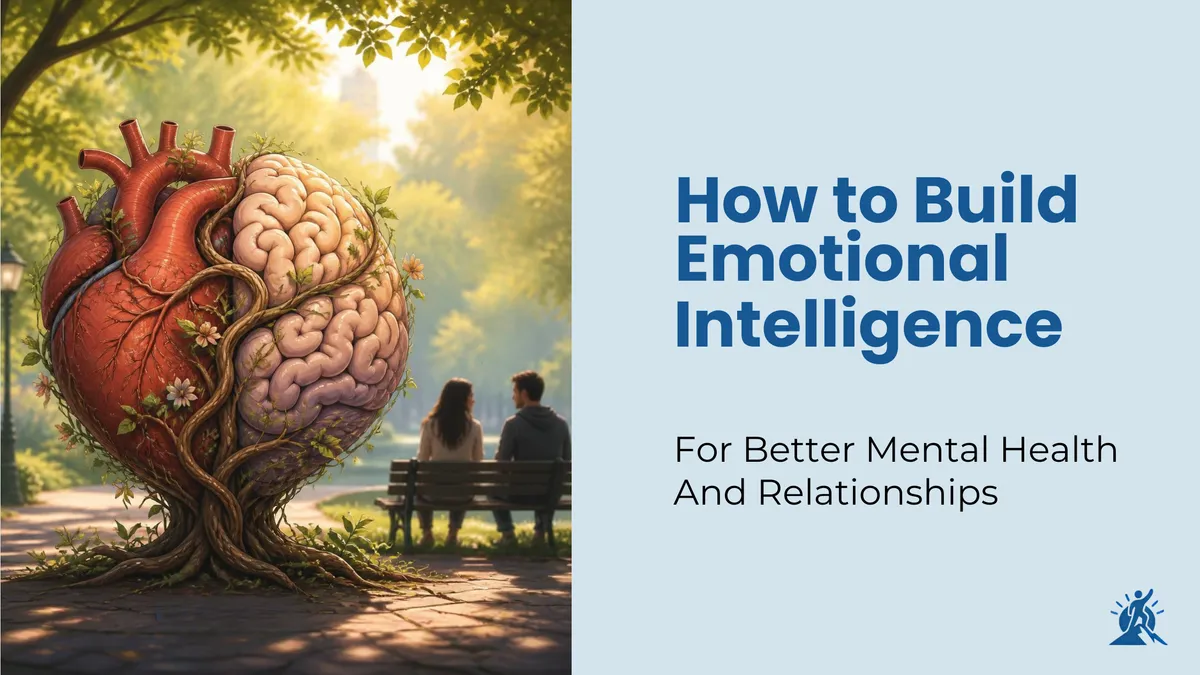
How to Build Emotional Intelligence for Better Mental Health and Relationships
How to Build Emotional Intelligence for Better Mental Health and Relationships
Introduction
You've probably heard "emotional intelligence" used as a kind of catch-all compliment — someone who's good with people, calm under pressure, easy to talk to. It's become such a common phrase that it's easy to assume it's just a personality trait: something you either have or you don't.
The research tells a more useful story. Emotional intelligence is genuinely definable, measurable, and — importantly — buildable. It plays a real role in how well you manage stress, navigate conflict, and sustain close relationships, and unlike some aspects of temperament, it responds meaningfully to deliberate practice.
In this article, we'll look at what emotional intelligence actually is according to the psychological research that first defined it, why it matters for both mental health and relationships specifically, and practical, evidence-based ways to build it — without needing to become a different kind of person to do so.
What Emotional Intelligence Actually Is
The term "emotional intelligence" was formally introduced by psychologists Peter Salovey and John Mayer, who defined it as a set of skills involved in the accurate appraisal and expression of emotion in oneself and others, the effective regulation of emotion, and the use of feelings to motivate, plan, and achieve goals in life.
Their most widely used framework — the four-branch ability model — breaks emotional intelligence into four distinct, learnable skills: perceiving emotions (recognising them in yourself and others), using emotions to facilitate thought (the ability to generate, use, and feel emotion as necessary to communicate feelings or employ them in cognitive processes), understanding emotions (including their causes and how they evolve), and managing emotions (regulating your own and responding effectively to others).
It's worth noting there are actually two broad traditions in Emotional Intelligence (EI) research: the ability model developed by Mayer and Salovey, which treats EI as a genuine form of intelligence measured through performance tasks, and various mixed models (popularised for a general audience by Daniel Goleman) that combine emotional skills with broader traits like motivation and social skills. Both traditions have contributed useful research, but the ability model tends to have the strongest empirical grounding as a distinct, trainable skill set — which is the framework this article draws on most directly.
Why Emotional Intelligence Matters for Mental Health
Emotional intelligence isn't just a workplace or leadership buzzword — it has a genuine, research-backed connection to mental health outcomes. Multiple studies have found that EI predicts real health-related outcomes, including higher life satisfaction, lower depression, and fewer health issues overall.
Part of why this connection exists comes down to what EI actually involves at a functional level: accurately perceiving your emotions, understanding what's driving them, and managing them effectively are foundational skills for navigating stress, avoiding unhelpful patterns like suppression or rumination, and recovering from difficult emotional experiences. In other words, EI isn't a separate wellbeing outcome — it's closely tied to the underlying mechanisms that make good mental health possible in the first place.
Why Emotional Intelligence Matters for Relationships
The research on emotional intelligence and relationships is particularly robust. A comprehensive meta-analysis pooling 90 effect sizes across 78 samples found a meaningful, statistically significant positive correlation between emotional intelligence and romantic relationship satisfaction, holding across a wide range of relationship types and measurement approaches.
The mechanisms behind this connection are fairly intuitive once you break them down. Higher emotional intelligence has been associated with better communication between partners and a greater ability to cooperate and successfully resolve conflict. People with stronger EI also tend to be better at empathic perspective-taking and show more cooperation when working through disagreements with a partner — skills that are directly protective against the kind of unresolved conflict that erodes relationship satisfaction over time.
The Good News: Emotional Intelligence Is Trainable
Perhaps the most encouraging finding in this area of research is that emotional intelligence isn't fixed. A meta-analysis specifically examining whether EI can be trained found genuine support for its trainability through structured intervention, with several individual studies showing that training programs improved both EI scores and related outcomes like job satisfaction and quality of social relationships.
That said, the research is honest about nuance here too: not every training program produces significant gains — some studies found no measurable change, particularly shorter or less theoretically grounded interventions — and reviewers have noted that well-designed studies with genuine control groups tend to show more reliable positive effects than less rigorous ones. The overall picture is encouraging, but it does suggest that how you build EI matters, not just whether you make the effort.
Practical, Evidence-Based Ways to Build Emotional Intelligence
Based on the four-branch model, building emotional intelligence means developing each of its component skills somewhat separately — perceiving, using, understanding, and managing emotions — rather than treating "EI" as one single thing to improve.
1. Perceiving Emotions: Build Accurate Self-Awareness
This is the foundational skill: accurately recognising what you're feeling, in yourself, as it happens — not after the fact, and not filtered through what you think you "should" be feeling.
Try this: A few times a day, pause and name your current emotional state as specifically as possible. Rather than "stressed," try to identify whether it's closer to frustration, overwhelm, disappointment, or anxiety — precision here is itself a skill that improves with practice.
2. Perceiving Emotions in Others: Practise Genuine Attention
Accurately reading others' emotional states — through tone, expression, and context, not just their words — is a distinct skill from managing your own emotions, and it underpins empathic perspective-taking, one of the mechanisms directly linked to relationship satisfaction.
Try this: In conversations, particularly difficult ones, deliberately notice what the other person's tone or body language suggests, separate from what they're actually saying, and check your reading against what they express.
3. Using Emotions: Let Feelings Inform, Not Just Interrupt
The "using emotions" branch of the model refers to harnessing emotional information to guide thinking and decision-making, rather than treating emotions purely as something to manage or suppress.
Try this: When making a decision, explicitly ask what your emotional response is telling you (excitement, hesitation, unease) alongside the practical considerations — emotions often carry genuinely useful information about what matters to you.
4. Understanding Emotions: Learn Their Patterns
This branch involves understanding the causes, progressions, and combinations of emotions — for example, recognising that irritability at the end of a long day is often really exhaustion, or that anxiety before a hard conversation often masks a fear of disappointing someone.
Try this: When a strong emotion shows up, ask what likely triggered it and what it tends to lead to if left unaddressed — building this kind of pattern recognition over time makes emotional responses feel less confusing and more predictable.
5. Managing Emotions: Build Regulation Skills Directly
This final branch — effectively regulating your own emotions and responding constructively to others' — is where much of the practical payoff for both mental health and relationships shows up.
Try this: Rather than either suppressing a strong emotion or acting on it immediately, practise a brief pause — naming the emotion, considering what response would actually serve the situation, and then choosing your next step deliberately rather than reactively.
6. Practise Communication Skills Directly
Because communication and conflict resolution are among the clearest mechanisms linking EI to relationship satisfaction, deliberately practising these skills — active listening, expressing needs clearly, staying engaged rather than withdrawing during disagreement — tends to have a fairly direct payoff.
Try this: In your next disagreement with someone close to you, try reflecting back what you heard before responding with your own perspective — this single habit does a lot of work for both accurate perception and constructive management of the interaction.
Key Takeaways
Emotional intelligence is a defined, research-based construct made up of four distinct skills: perceiving, using, understanding, and managing emotions — not a fixed personality trait.
Research links higher emotional intelligence to better mental health outcomes, including higher life satisfaction and lower depression.
A large-scale meta-analysis found a meaningful, consistent link between emotional intelligence and romantic relationship satisfaction, driven largely by communication and conflict-resolution skills.
Emotional intelligence is genuinely trainable, though the quality and structure of the effort matters — casual, unstructured attempts tend to be less effective than deliberate, consistent practice.
Practical Action Steps
Practise naming your emotional state with more specificity than usual, several times a day, for one week.
In your next difficult conversation, try reflecting back what you heard before responding with your own view.
When a strong emotion arises, pause and ask what likely triggered it and what pattern it tends to follow, before reacting.
Notice one decision this week where your emotional response might be carrying useful information worth factoring in, rather than dismissing.
If building emotional intelligence feels genuinely difficult — particularly around recognising or managing your own emotions — consider speaking with a psychologist, as this is well-established therapeutic territory, and structured support tends to produce more reliable gains than self-directed effort alone.
Conclusion
Emotional intelligence isn't about always saying the right thing or staying calm in every situation. It's about developing the ability to understand your emotions, respond to them thoughtfully, and connect more effectively with the people around you. While some people may appear naturally emotionally aware, research suggests that emotional intelligence is not a fixed trait—it's a set of skills that can be strengthened over time.
The encouraging news is that even small changes can make a meaningful difference. Learning to recognise your feelings, pause before reacting, and better understand the emotions of others can gradually improve your wellbeing, communication, and relationships. Progress rarely happens overnight, but consistent practice can help you build greater confidence in navigating both everyday challenges and difficult moments.
You don't need to become a different person to develop emotional intelligence. What matters is creating opportunities to practise these skills, one interaction and one conversation at a time. Over time, those small efforts can lead to a deeper understanding of yourself and stronger, healthier connections with others.
Strengthen Your Emotional Wellbeing
Whether you're looking to improve self-awareness, manage emotions more effectively, or build healthier relationships, Recover Mental Health can help you develop practical skills that fit into everyday life—one small step at a time.
Developed from more than 40 years of clinical experience, RECOVER provides a comprehensive range of practical, professional, evidence-based mental health resources, including guided relaxation, self-assessments, mood tracking, educational masterclasses, and proven strategies to support your emotional wellbeing.
Best of all, RECOVER is one of the most affordable mental health apps available today, making high-quality psychological support accessible for the cost of a cup of coffee a month!
Take the first step towards a healthier, calmer mind. Subscribe to RECOVER Mental Health today and put professional support in the palm of your hand.
RECOVER can be downloaded from Apple Store or Google Play Store by searching for Recover Mental Health or via the RECOVER website.