How to Recognise the Difference Between Stress and Anxiety
How to Build Emotional Intelligence for Better Mental Health and Relationships
Introduction
"I'm so stressed" and "I'm so anxious" often get used as if they mean the same thing — and honestly, in casual conversation, they usually do. But psychologically, stress and anxiety are genuinely distinct experiences, and knowing which one you're actually dealing with can change how you respond to it, what kind of support is likely to help, and whether it's something to manage yourself or consult a professional.
The confusion is understandable. Stress and anxiety share a lot of the same physical symptoms — tension, a racing heart, trouble sleeping — which makes them easy to confuse in the moment. But there is a meaningful difference underneath those shared symptoms, one that matters for understanding what you're actually experiencing.
In this article, we'll walk through how stress and anxiety are genuinely different, how one can gradually turn into the other, and how to tell which one best describes what you're feeling right now — along with practical, evidence-based next steps either way.
What Actually Separates Stress From Anxiety
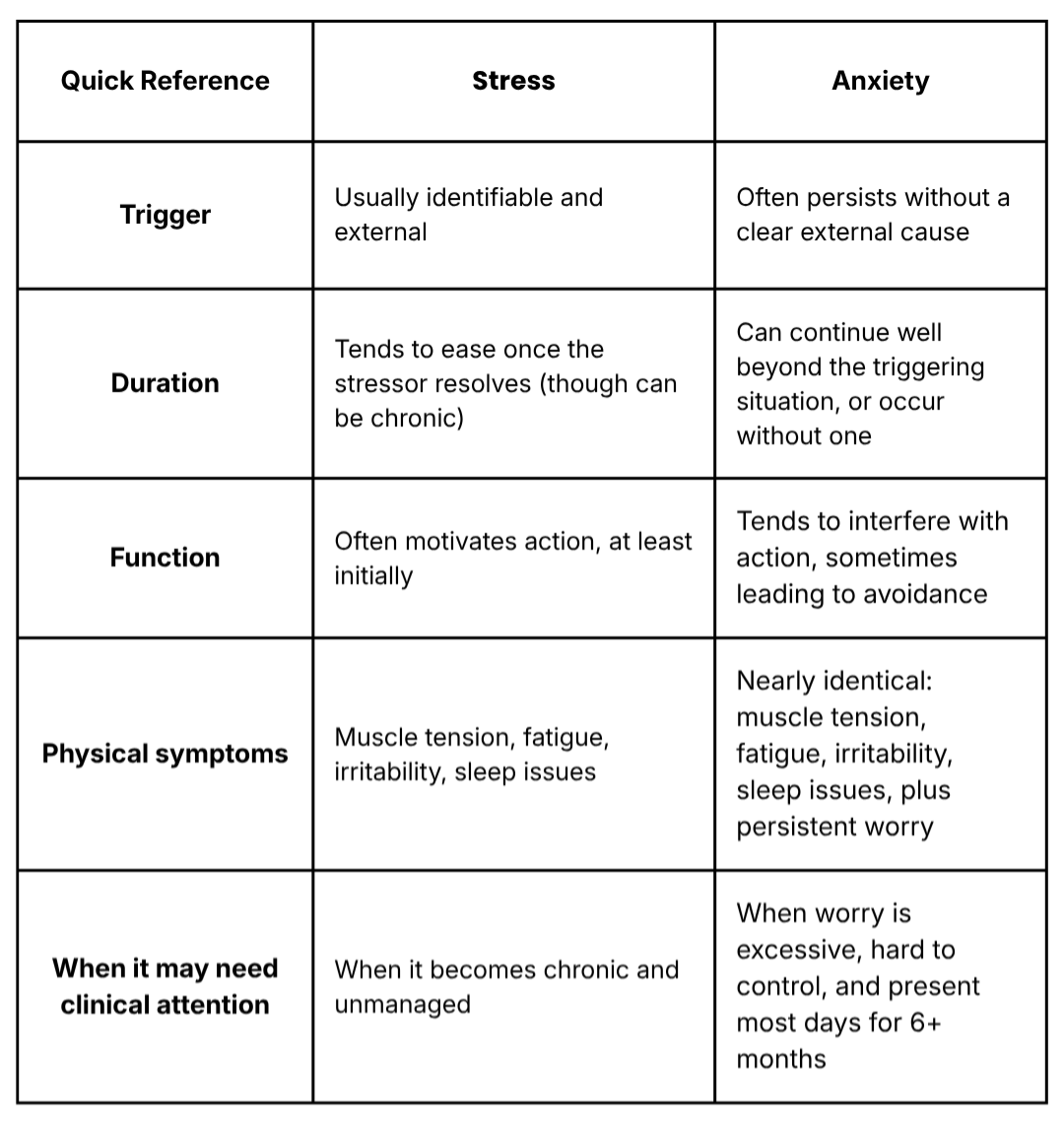
According to the American Psychological Association, the clearest distinguishing factor is the trigger: stress is typically caused by an external trigger, which can be short-term (a work deadline, an argument with a partner) or long-term (financial pressure, chronic illness, ongoing discrimination). Anxiety, by contrast, is defined by persistent, excessive worry that doesn't go away even in the absence of a stressor.
Put more simply: stress tends to be a response to something identifiable happening in your life right now. Anxiety can show up — and persist — even when nothing is actually going wrong at the moment. One freelance summary of this distinction captures it well: stress is what you feel when you have too much on your plate, while anxiety is what you feel when you worry about your plate even when it's empty.
This distinction is genuinely useful, but it's worth adding an important nuance: duration alone isn't a reliable way to tell them apart, since stress itself can be long-term too — chronic financial pressure or an ongoing difficult relationship are both examples of stress that can persist for months or years without technically becoming what psychologists classify as an anxiety disorder. The more reliable marker is whether the worry or distress continues even once the actual external pressure has eased or disappeared.
What They Have in Common (Which Is Why They're Easy to Confuse)
Stress and anxiety lead to a nearly identical set of symptoms, including insomnia, difficulty concentrating, fatigue, muscle tension, and irritability. Both also involve activation of the body's stress-response system — when you encounter a stressor, your body activates the hypothalamic-pituitary-adrenal (HPA) axis, releasing cortisol and adrenaline to prepare you for action.
Because the physical experience is so similar, many people reasonably describe both states using the same language. The difference tends to become clearer not in how it feels physically, but in what's actually driving it, and how it behaves once the external circumstance is no longer present.
How Stress Can Gradually Become Anxiety
One of the more clinically important points here is that stress and anxiety aren't always entirely separate categories — they exist on something closer to a continuum, and chronic stress is considered one of the more significant risk factors for developing generalised anxiety disorder over time.
The mechanism behind this is fairly well understood: when the body's stress response is activated repeatedly without adequate recovery time, the nervous system can become increasingly sensitised, eventually triggering anxiety-like responses to smaller and smaller stimuli that wouldn't have provoked much of a reaction during the initial stages of the emotion. In other words, prolonged, unaddressed stress can gradually train your nervous system toward a more anxious baseline, even without one specific triggering event.
Some signs that stress may be shifting into something closer to clinical anxiety include worry that continues well after the original stressful situation has actually resolved, and physical symptoms that persist without an identifiable current cause.
When Anxiety Becomes a Diagnosable Condition
It's worth being clear that everyday anxiety and a diagnosable anxiety disorder aren't the same thing — anxiety exists on a spectrum, ranging from everyday worry that most people experience at various points, to clinically significant anxiety disorders that meaningfully interfere with daily functioning.
Clinically, generalised anxiety disorder is characterised by excessive, hard-to-control worry occurring on most days for at least six months, often jumping between topics rather than staying fixed on one concern, and accompanied by the same physical symptoms of anxiety described earlier. According to the National Institute of Mental Health, anxiety disorders are among the most common mental health conditions in the United States, with an estimated 31.1% of adults experiencing one at some point in their lives.
Despite how common anxiety disorders are, treatment rates remain relatively low — only about a third of people with a diagnosed anxiety disorder receive treatment for it in a given year, according to figures reported by the American Institute of Stress, suggesting the gap here is less about how common or "serious" anxiety is, and more about recognition and access.
Quick Reference: Stress vs. Anxiety
Why This Distinction Matters
Understanding which of these you're actually experiencing has real, practical implications. Mental health challenges like depression often accompany anxiety, which can make anxiety harder to self-diagnose accurately without a proper clinical evaluation — meaning that if what you're experiencing feels more like anxiety than situational stress, that's genuinely worth bringing to a professional rather than trying to address on your own.
It also affects what kind of self-management is likely to help. Stress tied to a specific, identifiable cause often responds well to addressing that cause directly, or to general stress-reduction strategies. Anxiety that persists without a clear trigger typically benefits more from approaches that work directly with the thought patterns and physiological reactivity driving the worry — which is part of why cognitive behavioural therapy (CBT) is one of the most widely used therapeutic approaches for anxiety specifically.
Practical, Evidence-Based Next Steps
If What You're Experiencing Sounds More Like Stress
Identify the specific stressor where possible, and consider what is actually within your control to address.
Build in regular recovery periods, since inadequate recovery from repeated stress is part of what allows it to escalate into anxiety over time.
Use general stress-management strategies — physical activity, sleep consistency, and social support all have a solid evidence base for reducing stress-related symptoms.
If What You're Experiencing Sounds More Like Anxiety
Notice whether the worry persists even once a specific concern has resolved — this pattern is worth paying attention to rather than dismissing.
Consider whether the worry meets a duration threshold worth discussing with a professional (most days, for six months or more, is a recognised clinical marker).
Explore evidence-based approaches like CBT, which directly addresses the thought patterns that sustain anxiety, rather than only the physical symptoms.
Refer to the Anxiety Masterclass Series within RECOVER® Mental Health App, which consists of a full workshop on anxiety and its effective management.
Either Way
Track your symptoms for a week or two, noting whether they're tied to identifiable events or seem to persist independently — this pattern itself is often clarifying.
Don't feel you need to self-diagnose precisely before seeking support; a GP or psychologist can help clarify what you're actually experiencing.
Key Takeaways
Stress is generally a response to an identifiable external trigger; anxiety persists even without one, or continues well after a stressor has resolved.
Chronic, unmanaged stress is a recognised risk factor for anxiety developing over time, particularly when the nervous system doesn't get adequate recovery.
Both share nearly identical physical symptoms, which is why they're so often used interchangeably — the real distinction is in what's driving the experience and how long it lasts.
Anxiety disorders are common (affecting roughly one in three adults at some point) but remain under-treated, so if your experience sounds more like persistent anxiety than situational stress, that's genuinely worth raising with a professional.
Conclusion
Looking after your mental health isn't something that only happens during a therapy session. It's shaped by the small decisions you make every day—recognising when you're struggling, responding with self-compassion, and reaching for support before stress and anxiety become overwhelming. The earlier you notice these patterns, the more opportunity you have to build healthier habits that support your long-term wellbeing.
The encouraging news is that you don't have to wait until things feel unbearable before seeking help. Whether you're experiencing persistent stress, anxiety, low mood, or simply want to better understand your emotional wellbeing, taking action early can make a meaningful difference. Mental health support isn't only for moments of crisis—it's for anyone who wants to build resilience, develop healthier coping strategies, and care for their wellbeing before challenges become harder to manage.
Every step counts. Whether that step is learning more about your mental health, speaking with a trusted professional, or using evidence-based tools to support yourself between appointments, investing in your wellbeing is always worthwhile.
Support Your Mental Wellbeing Every Day
Developed from more than 40 years of clinical experience, RECOVER Mental Health App provides a comprehensive range of practical, professional, evidence-based mental health resources, including guided relaxation, self-assessments, mood tracking, educational masterclasses, and proven strategies to support your emotional wellbeing.
Best of all, RECOVER is one of the most affordable mental health apps available today, making high-quality psychological support accessible for the cost of a cup of coffee a month!
Take the first step towards a healthier, calmer mind. Subscribe to RECOVER Mental Health today and put professional support in the palm of your hand.
RECOVER can be downloaded from Apple Store or Google Play Store by searching for Recover Mental Health or via the RECOVER website.