The Hidden Impact of Emotional Suppression on Mental Health
How Your Thoughts Shape Anxiety: Understanding CBT Patterns in Simple Terms (Psychology App Insight)
Introduction
You're upset, but you push it down and carry on with your day. You're anxious before a big conversation, but you keep your face neutral and your voice steady. You're hurt by something someone said, but you swallow it rather than let it show. In the moment, this can feel like the responsible thing to do — professional, composed, not making things "a big deal."
But emotional suppression — deliberately hiding or holding back how you feel — isn't actually neutral. Decades of psychological research now show that pushing emotions down doesn't make them disappear; it tends to change where their impact shows up, often in ways that are far less visible and considerably harder to trace back to their source.
In this article, we'll look at what's actually happening in the mind and body during emotional suppression, why it feels like the safer option even when it isn't, what the research says about its cost to mental and physical health, and a well-studied, evidence-based alternative that tends to serve people far better.
What Emotional Suppression Actually Is
In psychological research, expressive suppression is defined as the deliberate inhibition of outward emotional expression after an emotion has already been triggered — in other words, the feeling still happens internally, but its outward signs (facial expression, tone of voice, tears, visible frustration) are consciously held back.
This distinction matters. According to the influential process model of emotion regulation developed by psychologist James Gross, suppression is classified as a "response-focused" strategy — it acts late, after the emotional reaction is already underway, rather than changing the emotion itself. Because of this timing, suppression requires ongoing self-monitoring to keep the expression contained, which is part of why it tends to be more mentally taxing than it might appear from the outside.
Why Suppression Doesn't Actually Reduce the Emotion
One of the more striking findings from decades of laboratory research is that suppression doesn't meaningfully reduce how intensely someone actually experiences an emotion — it only reduces how much of it shows on the outside. Early experimental work by Gross and colleague Robert Levenson found that suppressing emotional expression produced a mixed physiological picture, including signs of increased sympathetic nervous system activity, even though outward behaviour was reduced.
More recent research has confirmed and extended this: inhibiting negative emotions is considered more physiologically demanding than not regulating them at all, associated with greater sympathetic cardiovascular activation. In plain terms, suppressing an emotion doesn't switch it off — it tends to keep the body in an activated, effortful state while removing the outward signal that would normally let others (or you) recognise something that needs attention.
The Hidden Cost: What Research Says About Suppression's Impact
On Mental Health
Because expressive suppression requires persistent self-monitoring and modulation of emotional responses, it's associated with increased physiological arousal, anxiety, and negative affect. Chronic reliance on suppression can also intensify emotional dysregulation by increasing physiological arousal and promoting cognitive rumination — meaning the very act of suppressing a feeling can make it more likely to resurface later as repetitive, intrusive thinking.
A recent study examining college students found that habitual expressive suppression was linked to worsened depressive symptoms, consistent with a broader and growing body of research connecting habitual suppression to adverse mental health outcomes. That said, research findings aren't entirely uniform: one study of older adults found that while rumination and perceived stress strongly predicted anxiety, depression, and poorer physical health, suppression itself only weakly predicted depression and wasn't a significant predictor of the other outcomes — a useful reminder that suppression's impact can vary somewhat by context, age, and how it's measured, even though the broader pattern across the research base leans consistently negative.
On Physical Health
Emotional suppression's costs aren't limited to mood. Chronic suppression has been linked to activation of physiological stress systems, including the hypothalamic-pituitary-adrenal (HPA) axis and immune disruption, contributing to symptoms like heart palpitations and increased susceptibility to infection. This lines up with the broader chronic-stress research showing that prolonged physiological activation — of the kind suppression appears to sustain — takes a measurable toll on the body over time, including on sleep, muscle tension, and digestion.
On Relationships
Emotional expression plays an important role in social bonding and mutual understanding, and people who habitually suppress their emotions often find it harder to form or maintain close relationships as a result. This makes intuitive sense: emotional expression is one of the primary ways people signal what they need, what's bothering them, or what matters to them — suppressing it removes information that relationships generally rely on to function well, even when the suppression is well-intentioned (not wanting to "burden" someone, for instance)
On Coping More Broadly
People who habitually suppress emotions are also more likely to turn to secondary coping strategies like emotional eating, which suggests suppression doesn't resolve the underlying emotional need — it often just redirects it toward a different outlet, one that carries its own separate risks.
A Well-Studied Alternative: Cognitive Reappraisal
If suppression isn't especially effective at reducing the emotional impact, what does the research suggest instead? One of the most extensively studied alternatives is cognitive reappraisal — reinterpreting the meaning of a situation in a way that changes its emotional impact, applied early, before the full emotional reaction unfolds, rather than after.
Because reappraisal intervenes earlier in the process, it tends to have a considerably healthier profile than suppression: research comparing the two strategies has found that reappraisal is associated with healthier patterns of affect, social functioning, and wellbeing, and produces more prolonged psychological wellbeing and greater positive affect compared with suppression. Notably, one large study found that people with higher measured emotional intelligence tend to naturally lean toward reappraisal over suppression, suggesting this shift is a learnable skill rather than a fixed trait.
What Reappraisal Looks Like in Practice
Reappraisal isn't about denying that something is upsetting — it's about actively looking for an alternative, still-honest way of interpreting the situation, before the emotion has fully taken hold.
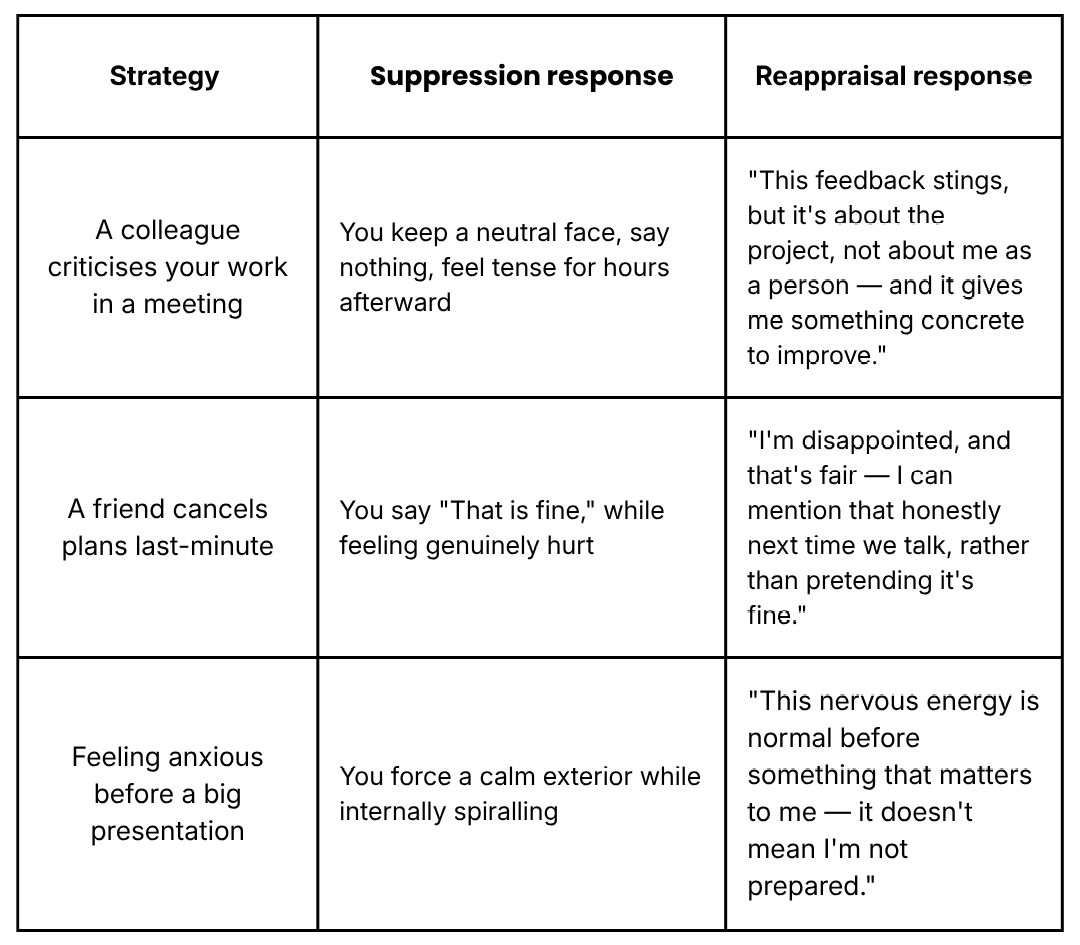
Reappraisal doesn't mean you never hold back an outward reaction in a given moment (sometimes that's genuinely appropriate, like in a professional setting). The difference is that reappraisal changes how you're relating to the feeling internally, rather than just masking it externally while the internal experience stays exactly as intense.
Key Takeaways
Suppressing an emotion doesn't reduce how intensely you experience it — it mainly hides the outward signs while the internal, physiological activation often continues or even increases.
Habitual suppression is linked to increased anxiety, rumination, and — in a growing body of research — depressive symptoms, alongside physical costs like elevated stress-hormone activity.
Suppression can also strain relationships, since emotional expression plays a genuine role in how people connect and understand each other.
Cognitive reappraisal — reinterpreting a situation's meaning early on — is a well-studied, healthier alternative associated with better long-term wellbeing.
Practical Action Steps
Notice one moment this week where you suppress a visible reaction — pause and name the actual feeling to yourself privately, even if you choose not to express it outwardly.
Practise reappraisal on one recurring stressor: write down the situation, your automatic interpretation, and one alternative, still-honest way of seeing it.
In a low-stakes relationship, try voicing a genuine reaction you'd normally suppress ("that actually disappointed me") and notice how it lands.
If you notice a pattern of turning to food, scrolling, or another habit shortly after suppressing a feeling, try naming the original emotion before reaching for the substitute coping behaviour.
If suppression feels like your default response most of the time, or is affecting your relationships, sleep, or physical health, consider speaking with a psychologist — building healthier emotion regulation skills is a well-established area of therapeutic work.
Conclusion
Keeping difficult emotions hidden can sometimes feel like the safest or most practical option, especially if you've spent years learning to stay composed and push through discomfort. But while emotional suppression may help you get through the moment, it rarely makes those feelings disappear. More often, it simply shifts the emotional burden elsewhere—into your stress levels, relationships, or overall wellbeing.
The encouraging news is that healthier ways of managing emotions can be learned. By practising skills like emotional awareness and reappraisal, it's possible to build a more honest and balanced relationship with your feelings without becoming overwhelmed by them. Progress rarely happens overnight, but even small, consistent changes can help you feel more connected to yourself and the people around you.
You don't need to express every emotion immediately to benefit from emotional openness. What matters is developing the ability to notice, understand, and respond to your feelings differently—so that they no longer remain hidden beneath the surface, shaping your wellbeing from behind the scenes.
Build Healthier Emotional Habits
Whether you've become accustomed to bottling things up, struggle to identify what you're feeling, or simply want to develop healthier ways of managing emotions, Recover Mental Health can help you build practical skills that fit into everyday life—one small step at a time.
Developed from more than 40 years of clinical experience, RECOVER provides a comprehensive range of practical, professional, evidence-based mental health resources, including guided relaxation, self-assessments, mood tracking, educational masterclasses, and proven strategies to support your emotional wellbeing.
Best of all, RECOVER is one of the most affordable mental health apps available today, making high-quality psychological support accessible for the cost of a cup of coffee a month!
Take the first step towards a healthier, calmer mind. Subscribe to RECOVER Mental Health today and put professional support in the palm of your hand.
RECOVER can be downloaded from Apple Store or Google Play Store by searching for Recover Mental Health or via the RECOVER website.