How Your Thoughts Shape Anxiety: Understanding CBT Patterns in Simple Terms (Psychology App Insight)
How Your Thoughts Shape Anxiety: Understanding CBT Patterns in Simple Terms (Psychology App Insight)
Introduction
A text goes unanswered for a few hours, and suddenly you're not just wondering if your friend is busy — you're rehearsing what you did wrong to upset them. A minor pain in your side turns, within minutes, into a mental spiral about what it could mean. A small mistake at work becomes, in your head, the reason you'll lose your job.
If your mind has a habit of leaping straight to the worst possible outcome — skipping right over the far more likely, far less dramatic explanations — you're describing a well-documented thinking pattern called catastrophizing. It's exhausting, it feels completely convincing in the moment, and it's genuinely one of the more common thought patterns psychologists work with.
The good news is that catastrophizing isn't something you're stuck with. In this article, we'll unpack what's actually happening when your mind catastrophizes, why it can feel so real, and walk through decatastrophizing — a specific, well-studied cognitive behavioral therapy (CBT) technique that psychologists often teach for exactly this pattern.
What Catastrophizing Actually Is
Catastrophizing is a cognitive distortion — a pattern of thinking that exaggerates the severity and probability of negative events, often triggered by automatic thoughts that feel accurate and urgent but aren't actually grounded in fact. It's less about intelligence or insight and more about how quickly and convincingly the mind can generate a worst-case scenario before slower, more rational thinking has a chance to catch up.
There's an interesting evolutionary angle here too: this kind of threat-anticipating thinking is thought to have evolved as a mechanism for preparedness — useful when facing genuine physical danger, but far less useful when applied to an unanswered text message or a work email. The mechanism hasn't changed even though the situations it's applied to mostly have.
Psychologist Aaron Beck, whose work forms much of the foundation of modern CBT, identified catastrophizing as one of several common cognitive distortions decades ago, and it remains one of the most frequently addressed patterns in cognitive therapy today. More recent research describes catastrophic thinking as a transdiagnostic process — meaning it shows up across a wide range of conditions, including anxiety disorders, depression, and chronic pain, rather than being tied to just one specific issue.
Why Catastrophizing Feels So Convincing
One reason catastrophizing is so hard to simply "talk yourself out of" is that it tends to become self-reinforcing. According to a model developed by Beck and colleague Robert Gellatly, catastrophic beliefs activate interpretive biases (interpreting ambiguous situations negatively) and attentional biases (noticing threat-related information more than neutral information), which in turn heightens anxiety — creating a self-reinforcing loop where each part strengthens the others. This loop narrows cognitive focus toward threat, which is part of why catastrophic thoughts can feel so absolute and hard to question in the moment they occur.
This also explains why catastrophizing doesn't respond well to simple reassurance ("it'll probably be fine") — because the pattern isn't really about the specific worry, it's about a broader tendency to overweight threat and underweight more likely alternatives. Addressing it usually requires actually examining the thought itself, rather than just trying to feel differently about it.
Why This Matters If Left Unaddressed
Catastrophizing isn't just an unpleasant mental habit — research consistently links it to increased anxiety, depression, and impaired day-to-day functioning. In the context of physical health specifically, catastrophizing has also been identified as a significant predictor of pain-related distress and disability, with people who catastrophize about pain tending to experience it as more intense and more disabling than people who don't, even when the underlying physical cause is similar.
Left unchecked, catastrophizing also tends to reinforce avoidance — if your mind consistently predicts the worst outcome from a given situation, it becomes a natural next step to avoid that situation altogether, which can gradually shrink the range of things you feel able to do.
Decatastrophizing: The CBT Technique
Decatastrophizing is a cognitive behavioral therapy technique, developed within the cognitive therapy tradition established by Aaron Beck, specifically designed to target these exaggerated threat appraisals. Rather than trying to suppress or ignore catastrophic thoughts, it works by directly examining them — assessing the realistic probability of the feared outcome and developing a more balanced, evidence-based alternative.
How Decatastrophizing Works, Step by Step
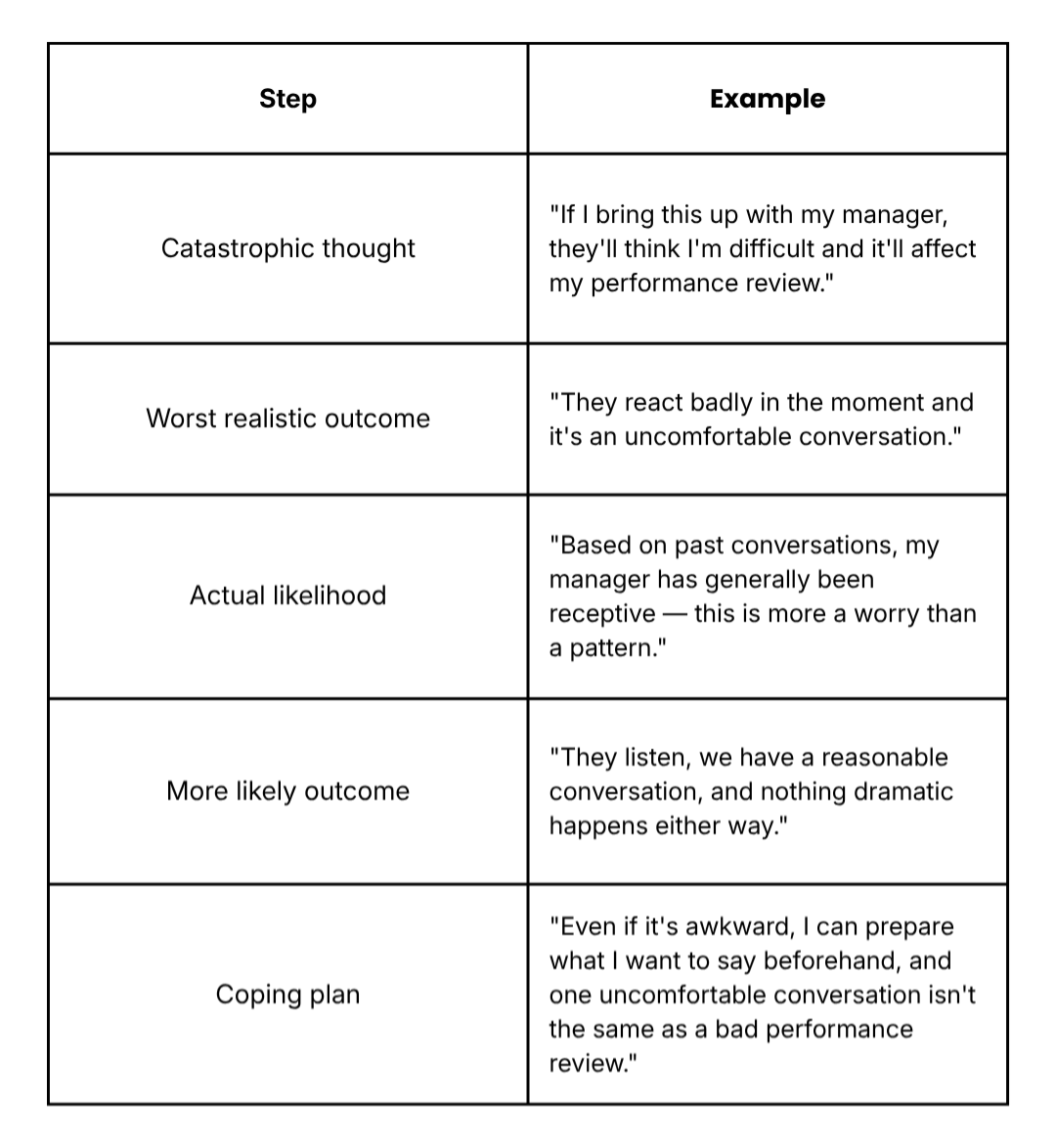
The technique typically follows a structured sequence: identify the catastrophic thought, examine the worst-case scenario, assess its actual likelihood, consider more realistic alternatives, and identify coping strategies for handling the situation even if a difficult outcome did occur.
1. Name the catastrophic thought specifically. Rather than a vague sense of dread, get precise: what exactly is your mind predicting? ("If I make a mistake in this presentation, I'll be seen as incompetent and it will affect my career.")
2. Ask: what's the worst that could realistically happen? This step can feel counterintuitive — actually naming the worst-case scenario, rather than avoiding it — but doing so often reveals that the "worst case" is less catastrophic once it's actually spelled out, rather than left as a vague, looming threat.
3. Assess the actual likelihood. Ask yourself honestly: based on past experience and available evidence, how likely is this outcome, really? People who catastrophize consistently overestimate the probability of negative outcomes, so this step often provides a useful reality check when done honestly rather than rhetorically.
4. Consider the most likely outcome, not just the worst one. What's actually more probable than the catastrophic scenario? For most everyday situations, the realistic outcome is considerably milder than the one the anxious mind jumped to first.
5. Identify how you'd cope, even in the worst case. This step matters because much of the distress in catastrophizing comes not just from the feared event itself, but from an underlying (often unexamined) belief that you wouldn't be able to handle it. Explicitly identifying your coping resources — support people, past experience managing hard things, practical steps you could take — tends to reduce the perceived threat considerably.
A Worked Example
Why This Technique Has Genuine Evidence Behind It
Decatastrophizing isn't a self-help trend — it's a core, well-established component of cognitive behavioral therapy, one of the most extensively researched approaches in psychology. Clinicians describe it as a form of cognitive reappraisal that supports emotional regulation and measurably reduces catastrophic thinking and associated anxiety. It's used not only for generalized anxiety, but also as part of treatment for panic disorder — where therapists sometimes use structured exercises to help people directly test the accuracy of their catastrophic beliefs about bodily sensations, which tends to durably shift the misinterpretation driving the panic response.
Because catastrophic thinking cuts across so many conditions, addressing it directly through decatastrophizing tends to have benefits that extend beyond any single diagnosis — improving general anxiety management, emotional regulation, and engagement with more effective coping strategies overall.
Key Takeaways
Catastrophizing is a well-documented cognitive distortion, not a personal failing — it's one of the more common patterns psychologists work with.
It tends to become self-reinforcing through a loop of interpretive and attentional biases, which is part of why simple reassurance rarely resolves it.
Decatastrophizing works by directly examining the catastrophic thought — assessing its real probability, considering more likely alternatives, and identifying how you'd cope either way.
This technique has a strong evidence base within CBT and is used across a range of conditions, from generalized anxiety to panic disorder to chronic pain.
Practical Action Steps
Next time you notice a catastrophic thought, write it down specifically rather than leaving it as a vague sense of dread.
Walk through the five decatastrophizing steps on paper: name the thought, identify the worst realistic case, assess its actual likelihood, consider the more probable outcome, and note how you'd cope either way.
Practice this on a low-stakes worry first, to build familiarity with the process before applying it to something more distressing.
Notice if avoidance has crept into your life around a specific catastrophic fear, and consider what a small, manageable step back toward that situation might look like.
If catastrophizing is frequent, distressing, or connected to panic symptoms or chronic pain, consider speaking with a psychologist — decatastrophizing is a core, well-evidenced CBT technique, and a trained clinician can help you apply it to the specific patterns you're experiencing.
Conclusion
When your mind automatically jumps to the worst-case scenario, it can feel as though those thoughts are facts rather than fears. Catastrophic thinking often develops as a way of trying to predict and prepare for uncertainty, but over time, it can leave you feeling overwhelmed, anxious, and stuck in cycles of worry.
The encouraging news is that these thought patterns can change. By learning to recognize catastrophic thinking, question your assumptions, and practice techniques like decatastrophizing, you can gradually create more space between your thoughts and your emotional reactions. Progress rarely happens overnight, but even small, consistent shifts can help you feel calmer, more grounded, and better equipped to cope with uncertainty.
Decatastrophizing isn't about ignoring life's challenges or forcing yourself to "think positively." It's about building the skills to respond to anxious thoughts differently—so that your mind no longer treats every uncertainty as a disaster waiting to happen.
Challenge Anxious Thoughts with Confidence
Whether you're navigating persistent worry, overthinking, or a tendency to expect the worst, Recover Mental Health can help you develop practical strategies that fit into everyday life—one small step at a time.
Developed from more than 40 years of clinical experience, RECOVER provides a comprehensive range of practical, professional, evidence-based mental health resources, including guided relaxation, self-assessments, mood tracking, educational masterclasses, and proven strategies to support your emotional wellbeing.
Best of all, RECOVER is one of the most affordable mental health apps available today, making high-quality psychological support accessible for the cost of a cup of coffee a month!
Take the first step towards a healthier, calmer mind. Subscribe to RECOVER Mental Health today and put professional support in the palm of your hand.
RECOVER can be downloaded from Apple Store or Google Play Store by searching for Recover Mental Health or via the RECOVER website.