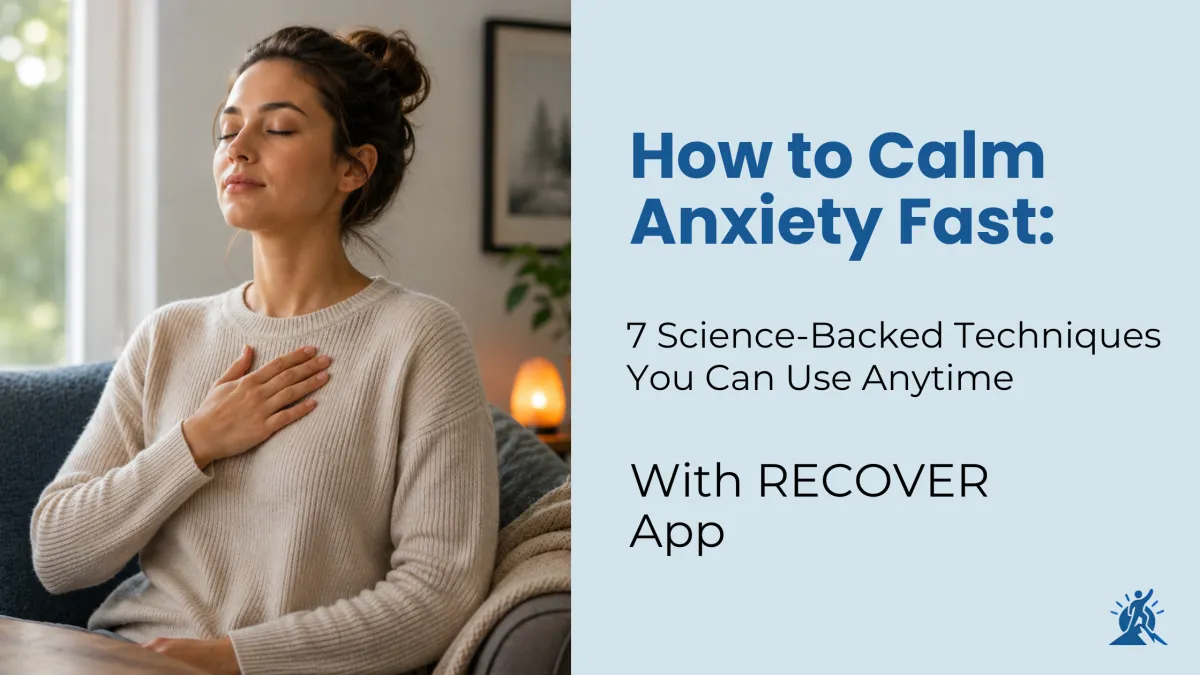
How to Calm Anxiety Fast: 7 Science-Backed Techniques You Can Use Anytime with RECOVER App
Why Your Brain Creates Anxiety: 7 Science-Backed Reasons Behind Worry
Introduction
Anxiety is one of the most common mental health experiences in the modern world. It can show up as racing thoughts, overthinking, panic, muscle tension, sleep struggles, or constant worry about the future. For many people, anxiety feels confusing and exhausting — especially when there doesn’t seem to be an obvious reason for it.
But anxiety is not a personal weakness or character flaw.
The brain’s threat detection and precautionary response systems are designed to detect danger and motivate protective action. Understanding why anxiety happens can help reduce shame, build self-awareness, and make it easier to manage emotional stress in healthier ways.
The good news is that neuroscience shows the brain is adaptable. With the right support, coping strategies, and mental wellness tools, anxious thought patterns can become more manageable over time.
RECOVER® was designed to support emotional wellbeing through science-based mental wellness tools, mindfulness practices, guided exercises, and psychology-informed strategies that help users better understand and manage anxiety.
Here are 7 science-backed reasons your brain creates anxiety and worry.
1. The Brain’s Threat Detection System (Amygdala)
At the center of anxiety is a small part of the brain called the amygdala. Think of it as your brain’s internal alarm system or smoke detector. Its job is to constantly scan for possible danger and keep you safe.
Thousands of years ago, this system protected humans from predators and life-threatening situations. Today, however, the same alarm system reacts to modern stressors like:
work pressure
financial stress
relationship conflict
social judgment
uncertainty about the future
The challenge is that the amygdala often cannot distinguish between real physical danger and perceived emotional threats. As a result, it can trigger anxiety even when you are objectively safe.
Why It Matters
An overactive amygdala can lead to:
heightened anxiety
panic reactions
emotional overwhelm
increased stress sensitivity
How RECOVER Can Help
The RECOVER Mental Health App offers guided mindfulness exercises, calming techniques, and breathing practices that help regulate the nervous system and reduce emotional reactivity during stressful moments.
2. The Fight-or-Flight Response
When your brain senses danger, it activates the fight-or-flight response — a biological survival mechanism designed to protect you during emergencies.
Your body releases stress hormones like:
cortisol
adrenaline
These chemicals prepare your body to react quickly by:
increasing heart rate
speeding up breathing
tightening muscles
sharpening alertness
While this response is helpful in actual emergencies, modern life can trigger it constantly through everyday stress.
Why It Matters
Chronic activation of the stress response may contribute to:
burnout
fatigue
sleep problems
panic symptoms
chronic stress
How RECOVER Can Help
RECOVER provides guided breathing exercises and grounding tools designed to calm the nervous system and help users shift out of survival mode more effectively.
3. Your Brain’s Negativity Bias
Studies have shown that the human brain naturally pays more attention to threats than positive experiences. This is called negativity bias, and it developed as a survival advantage.
Your brain is more likely to focus on:
criticism
mistakes
potential risks
worst-case scenarios
Uncertainty
Even when positive things happen, the brain often prioritizes possible problems because it believes this increases safety.
Why It Matters
Negativity bias can increase:
overthinking
self-doubt
fear-based thinking
chronic worry
How RECOVER Can Help
RECOVER includes gratitude exercises, positive reflection prompts, and emotional awareness tools that help users gradually shift attention toward balanced thinking patterns.
4. The Rumination Loop
Rumination happens when the brain repeatedly replays worries, fears, or stressful situations without reaching a solution.
During anxiety, the emotional part of the brain becomes more dominant while the logical thinking areas become less active. This creates repetitive thought loops that feel productive but often increase emotional distress.
Examples of rumination include:
replaying conversations repeatedly
imagining worst-case outcomes
overanalyzing mistakes
constantly asking “what if?”
Why It Matters
Rumination can:
increase anxiety symptoms
disrupt concentration
worsen emotional exhaustion
make stress feel never-ending
How RECOVER Can Help
Neuroscience proves that the brain naturally wants predictability and control. When outcomes feel uncertain, the brain often interprets that uncertainty as danger.
5. Intolerance of Uncertainty
The brain naturally wants predictability and control. When outcomes feel uncertain, the brain often interprets that uncertainty as danger.
This explains why situations like:
waiting for results
job uncertainty
unanswered messages
relationship ambiguity
unexpected life changes
can trigger strong anxiety responses.
Interestingly, research suggests that uncertainty itself often creates more stress than receiving negative news.
Why It Matters
Fear of uncertainty may lead to:
excessive reassurance seeking
avoidance behaviors
overplanning
constant worry about the future
How RECOVER Can Help
RECOVER supports emotional resilience through grounding tools, stress-management exercises, and mindfulness techniques that help users tolerate uncertainty more calmly.
6. Past Experiences and Learned Anxiety Patterns
Your brain learns from past experiences. If you’ve experienced trauma, panic attacks, chronic stress, or emotionally difficult situations, your nervous system may become more sensitive over time.
This creates stronger neural pathways connected to fear and worry, making anxiety easier to trigger in the future.
However, the brain is capable of change through a process called neuroplasticity.
Why It Matters
Past experiences can influence:
emotional triggers
stress sensitivity
automatic fear responses
coping behaviors
How RECOVER Can Help
RECOVER encourages consistent emotional wellness habits that help users build healthier coping patterns and improve emotional regulation over time.
7. Sleep Deprivation and Physical Stress
Mental health and physical health are deeply connected. When you’re exhausted, overwhelmed, dehydrated, or chronically stressed, your brain becomes less effective at regulating emotions.
Sleep deprivation weakens the prefrontal cortex — the part of the brain responsible for decision-making, emotional regulation, and rational thinking — while increasing amygdala activity.
This can make anxiety feel more intense and harder to manage.
Why It Matters
Poor physical wellness may increase:
emotional reactivity
anxious thoughts
irritability
fatigue
stress sensitivity
How RECOVER Can Help
RECOVER supports healthy daily wellness habits through mindfulness routines, emotional check-ins, calming exercises, and stress management tools designed to improve overall wellbeing.
The Hopeful Truth About Anxiety
Although anxiety can feel overwhelming, it’s important to remember that your brain is trying to protect you — even if the response sometimes becomes excessive.
The encouraging news is that the brain can adapt and heal.
Research in neuroscience and psychology shows that anxiety symptoms can improve through:
mindfulness practices
cognitive behavioral strategies (CBT)
therapy and emotional support
gradual stress exposure
healthy routines
nervous system regulation
Anxiety is not permanent, and it does not define who you are.
With greater understanding, self-awareness, and consistent support, it is possible to build healthier emotional patterns and feel more in control of your mental wellbeing.
RECOVER was created to help individuals navigate anxiety with practical, science-backed mental wellness tools that support emotional balance, self-awareness, and daily stress management.
Ready to better understand and manage your anxiety? Explore RECOVER and begin building healthier emotional habits today.