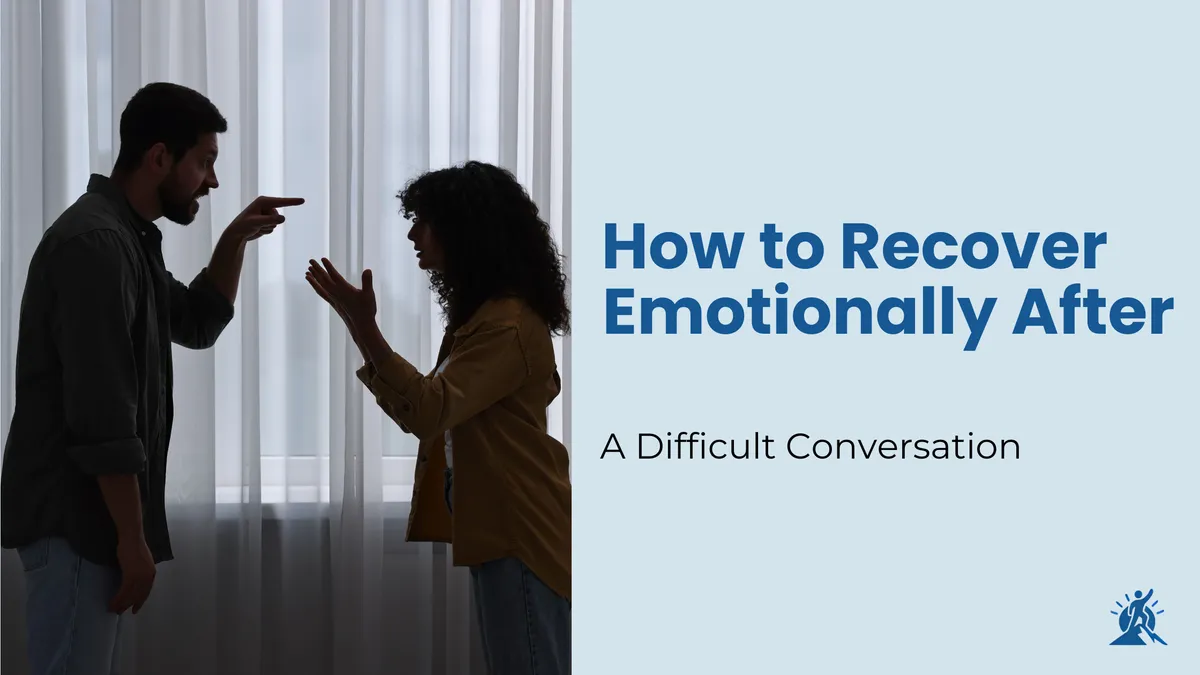
How to Recover Emotionally After a Difficult Conversation
How to Recover Emotionally After a Difficult Conversation
Introduction
The conversation ended twenty minutes ago, but your heart is still racing. Your hands feel slightly shaky. You're replaying the exchange, drafting the perfect comeback you didn't think of at the moment, or quietly wondering if you said too much — or not enough. Logically, you know it's over. Physically and emotionally, you're still very much in it.
This isn't a lack of resilience. It's a well-documented physiological response, and understanding what's actually happening in your body during and after a difficult conversation can make a real difference in how quickly — and how well — you recover from it.
In this article, we'll look at the psychology and physiology of what happens during a hard conversation, why some people bounce back faster than others, and practical, evidence-based steps for genuinely recovering afterward — not just distracting yourself until the feeling hopefully fades.
What's Actually Happening in Your Body
The overwhelmed, shaky, hard-to-think-straight feeling that follows a difficult conversation has a name in psychological research: flooding, referring to a flood of stress hormones like adrenaline and cortisol into the nervous system, generating a genuine fight-or-flight response. John Gottman's research, conducted over decades of studying couples in conflict, found that during intense arguments, heart rate and stress hormones climb — and once heart rate rises significantly above baseline, people become physiologically unable to access the kind of listening, empathy, and problem-solving that a difficult conversation actually requires.
This matters because it explains something many people experience but rarely have language for: it's not that you're choosing to be defensive, forgetful, or unable to think clearly after a hard conversation — your body has genuinely shifted into a state where clear thinking is temporarily much harder to access. This isn't unique to romantic relationships either; the same physiological pattern shows up in many emotionally charged situations, including difficult conversations at work, with family, or with friends.
Why Recovery Time Varies From Person to Person
One of the more striking findings from this research is that people don't all recover from flooding at the same rate. Gottman's research found that men's physiological stress responses tend to be more intense and take longer to recover from than women's, a pattern he theorised may reflect evolutionary differences — though it's worth noting these are population-level averages, and individual variation is genuinely significant, meaning this isn't a reliable predictor for any specific person.
What is more consistently useful is knowing that recovery generally isn't instant, no matter who you are — the body needs actual time to physiologically stand down, not just an internal decision to "move on."
How Long Recovery Actually Takes
This is genuinely useful information: Gottman's research found that heart rate typically returns to baseline in about 20 minutes for most people — but critically, only if they actively distract themselves from the conflict during that time. If instead that time is spent ruminating — replaying the argument, rehearsing what you should have said, mentally building your case — heart rate doesn't reliably drop, and the physiological arousal tends to persist well beyond the 20-minute mark.
This is an important, and slightly counterintuitive, finding: the instinct to keep thinking it through, to make sense of it or plan your response, is often exactly what keeps your body in an activated state for longer. Genuine recovery requires actively shifting attention away from the conflict, not analysing your way out of the feeling.
Recognising When You're Still Flooded
Before recovery strategies can help, it's useful to recognise the signs that you're still in a flooded state, rather than genuinely calm. Common indicators include an elevated heart rate, shortness of breath, difficulty concentrating on anything other than the conversation, a persistent replaying of what was said, and a general sense of being unable to think clearly about the situation or anything else.
It's worth being clear that self-soothing in this context is not the same as avoidance, emotional shutdown, or simply walking away from a problem. It's a deliberate pause that allows your nervous system to regulate before you engage further — with the conversation, the other person, or even your own reflective thinking about what happened.
Practical, Evidence-Based Ways to Recover
1. Take an Actual Break — At Least 20 Minutes
A minimum of 20 minutes is generally needed to allow your body's physiological response to return to baseline. This isn't about avoiding the issue permanently — it's a temporary, deliberate pause that makes it possible to engage constructively afterward, whether that's continuing the conversation or simply processing what happened.
2. Actively Distract, Don't Ruminate
Because rumination keeps heart rate elevated, the most effective use of a recovery break involves genuinely shifting your attention elsewhere, rather than using the time to mentally rehearse the conversation. Try this: Engage with something that requires enough attention to genuinely occupy your mind — a walk, music, a task that requires focus — rather than sitting with your thoughts still centred on the conversation.
3. Use Physical Self-Soothing Techniques
Because flooding is a physiological state that hijacks your thinking during conflict, physical calming strategies tend to be genuinely effective at helping your body recover, not just your mind. There are various strategies to help shift your nervous system out of its activated state.
Refer to RECOVER® Mental Health App, which covers a variety of strategies to calm and deactivate your nervous system.
4. Notice Your Physical Cues Early
Building awareness of your own early signs of flooding — a tightening chest, a racing heart, shallow breathing — makes it easier to recognise when you need a break before things escalate further, rather than only recognising it in hindsight.
Try this: During or immediately after a difficult conversation, do a brief body check: where do you feel tension or activation right now? Naming it can itself be a small first step toward regulating it.
5. Wait Before Revisiting the Conversation — With Yourself or the Other Person
Whether you're planning to continue the conversation with the other person, or simply trying to think it through on your own, it's worth waiting until you're genuinely out of a flooded state first. Attempting to resolve or process conflict while still physiologically overwhelmed rarely leads to real understanding or repair — the empathy, perspective, and clear problem-solving needed for that tend to return naturally once your nervous system has settled.
6. Reframe the Break as Care, Not Avoidance
It can help to consciously reframe a recovery pause as an act of respect toward yourself (and, if relevant, the relationship), rather than framing it as failing to "deal with it properly." Giving yourself — and where applicable, the other person — the opportunity to tend to a flooded nervous system is a legitimate and evidence-supported part of handling conflict well, not a way of avoiding it.
Key Takeaways
The overwhelmed, shaky feeling after a difficult conversation has a real physiological basis — a genuine stress response, not a personal shortcoming.
Recovery generally takes at least 20 minutes, but only if that time is spent genuinely distracted, rather than replaying or rehearsing the conversation.
Physical self-soothing strategies work directly on the nervous system, which is what actually needs to settle.
Taking a recovery break before continuing a conversation or trying to process it fully is a legitimate, evidence-based strategy, not avoidance.
Practical Action Steps
After your next difficult conversation, take a genuine 20-minute break before continuing it or trying to fully process it.
During that break, deliberately engage in something distracting — a walk, music, a task — rather than replaying the conversation in your head.
Practise the strategies outlined in RECOVER® Mental Health App as a direct way to help your nervous system settle.
Notice your own early physical signs of flooding (racing heart, shallow breathing, tightening chest) so you can recognise the need for a break sooner next time.
If difficult conversations consistently leave you flooded for long periods, or this pattern is affecting your relationships significantly, consider speaking with a psychologist — these are well-studied, teachable regulation skills.
Conclusion
Difficult conversations don't always end when the conversation itself is over. Even after the words have stopped, your body may still be responding to the stress of what happened—leaving you feeling shaky, distracted, tense, or mentally stuck on what was said. This isn't a sign that you're overreacting or failing to cope. Your nervous system may simply need time and the right conditions to return to a calmer state.
The encouraging news is that recovery can be supported. Rather than immediately analysing the conversation, replaying what happened, or forcing yourself to move on, giving yourself a genuine recovery period can help your body settle first. Physical self-soothing, meaningful distraction, and time away from rumination can create the space needed to regain perspective and respond more thoughtfully.
You don't have to ignore what happened or suppress your emotions. The goal is to recover first, then decide what the situation needs—whether that's reflection, a follow-up conversation, or simply letting it go. With practice, learning to recognise when you're emotionally flooded and giving yourself permission to pause can become a valuable part of maintaining your emotional wellbeing.
Support Your Mental Wellbeing Every Day
Developed from more than 40 years of clinical experience, RECOVER Mental Health App provides a comprehensive range of practical, professional, evidence-based mental health resources, including guided relaxation, self-assessments, mood tracking, educational masterclasses, and proven strategies to support your emotional wellbeing.
Best of all, RECOVER is one of the most affordable mental health apps available today, making high-quality psychological support accessible for the cost of a cup of coffee a month!
Take the first step towards a healthier, calmer mind. Subscribe to RECOVER Mental Health today and put professional support in the palm of your hand.
RECOVER can be downloaded from Apple Store or Google Play Store by searching for Recover Mental Health or via the RECOVER website.