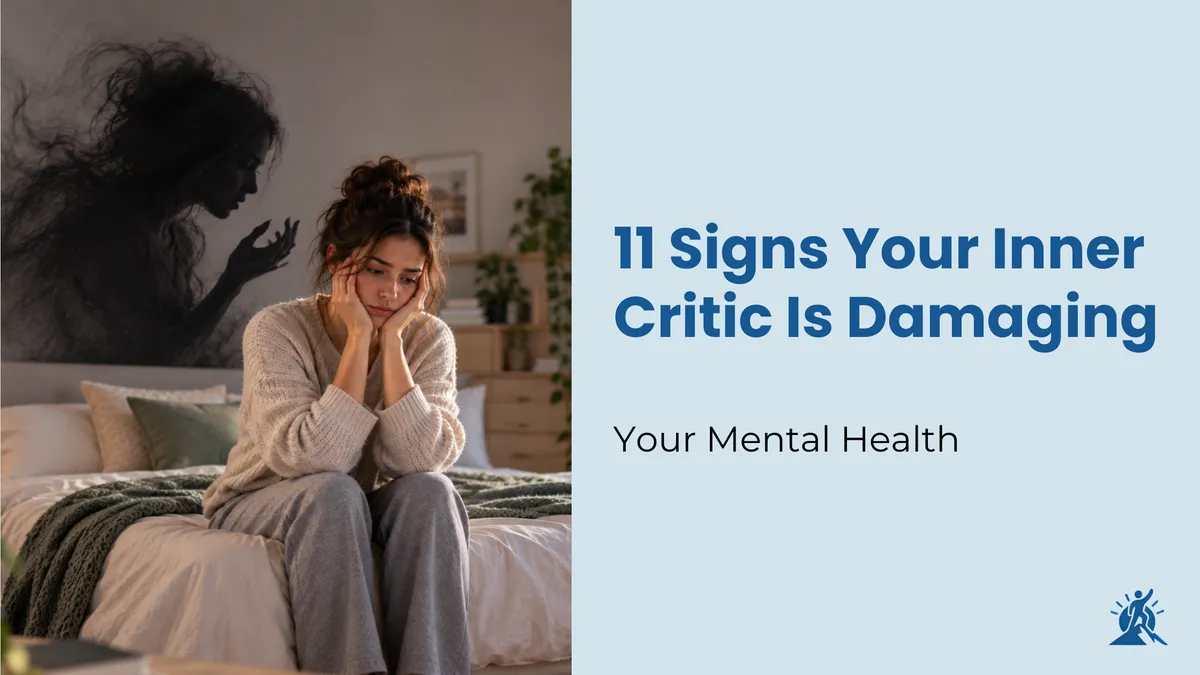
11 Signs Your Inner Critic Is Damaging Your Mental HealthNew Blog Post
11 Signs Your Inner Critic Is Damaging Your Mental Health
Introduction
There's a voice many people carry that rarely gets a day off. It's the one that says "you should have known better" after a small mistake, "you're not good enough" before a challenge, or "why can't you just get it together" on an ordinary hard day. For a lot of people, this voice is so constant it barely registers as separate from their own thoughts — it just feels like the truth.
Psychologists refer to this pattern as the inner critic: a persistent internal voice shaped by self-doubt, fear of failure, and internalised negative beliefs, often originating from past experiences, social conditioning, or early relationships. In moderation, a degree of self-reflection is genuinely useful. But when this voice becomes harsh, constant, and disproportionate, it stops functioning as helpful feedback and starts functioning as something closer to an ongoing internal attack — one with real, documented consequences for mental health.
In this article, we'll walk through 11 signs that your inner critic may have crossed from useful self-reflection into something genuinely damaging, what the research says about why this distinction matters, and evidence-based ways to start working with — rather than against — this part of your inner world.
Self-Correction vs. Self-Attacking: An Important Distinction
Before getting into the specific signs, it's worth understanding a key distinction from the research: psychologist Paul Gilbert and colleagues identified two meaningfully different forms of self-criticism — self-correction, which involves critiquing a specific behaviour or mistake, and self-hating (or self-attacking), which involves a more hostile, generalised attack on the self as a whole. The more self-attacking a person's inner critic becomes, the harsher they tend to be on themselves when they make mistakes or fall short of their own standards, and this form carries meaningfully more harmful consequences than straightforward self-correction.
This distinction matters because it explains why "having standards" and "being self-critical in a damaging way" aren't actually the same thing. The difference isn't whether you notice a mistake — it's whether that noticing stays specific and constructive, or expands into a broader, harsher judgment about who you are as a person.
The 11 Signs
1. Your Self-Talk Attacks Character, Not Behaviour
There's a meaningful difference between "that was a mistake" and "I'm an idiot." If your internal commentary regularly jumps from a specific action to a broader judgment about your worth or character, this reflects the more harmful, self-attacking pattern researchers have identified, rather than constructive self-correction.
2. The Criticism Is Constant, Not Occasional
Everyone has moments of self-doubt. A damaging inner critic is different in frequency — it shows up repeatedly throughout an ordinary day, not just around genuinely significant mistakes or setbacks.
3. You Struggle to Accept Compliments or Success
If praise or achievement tends to be quickly dismissed, minimised, or met with an internal "yes, but," this reflects a pattern where the inner critic doesn't allow evidence of competence or worth to genuinely register.
4. You Notice Yourself Ruminating on Mistakes Long After They've Passed
A harsh inner critic often doesn't let a mistake go once it's been noticed — it tends to replay and rehearse it, well beyond the point where reflecting on it serves any useful purpose.
5. Your Standards Feel Impossible to Actually Meet
If your internal bar consistently moves just out of reach every time you get close to it, this may reflect what researchers describe as perfectionistic concerns — a harsher, more self-critical form of perfectionism that has notably stronger links to anxiety, social anxiety, depression, and OCD than simply holding high personal standards.
6. You Feel Shame, Not Just Disappointment, After Falling Short
Shame — a broader, more painful sense that something is wrong with you as a person — is a common companion of a harsh inner critic, distinct from the more manageable feeling of disappointment tied to a specific outcome.
7. You Avoid Trying New Things Because of How You Might Judge Yourself Afterward
A sufficiently harsh inner critic can begin to shape behaviour proactively, not just react to it — leading people to avoid situations where they might fall short, purely to avoid the anticipated self-criticism that would follow.
8. Criticism Intensifies Around Specific Themes (Body, Performance, Relationships)
The inner critic's focus often clusters around particular vulnerable areas — for example, in the context of disordered eating, the critic's focus is frequently weight, appearance, or control, while in other contexts it may attach more strongly to performance or relational adequacy.
9. Your Inner Voice Sounds Distinctly Harsh or Familiar From Somewhere Specific
Some people notice their inner critic echoes a particular tone or specific phrases from childhood or a past relationship. Authoritarian parenting styles in particular have been linked to higher levels of self-criticism in children, meaning this internal voice sometimes has an identifiable origin, even when it now runs largely on autopilot.
10. It's Hard to Separate Reasonable Feedback From the Critic's Voice
For people with a particularly loud inner critic, it can become genuinely difficult to distinguish useful, accurate feedback (from yourself or others) from the reflexive, disproportionate harshness of the critic — everything starts to sound the same in tone, regardless of how minor or major the actual issue is.
11. You Notice Physical or Emotional Exhaustion From the Pattern Itself
Beyond its content, the sheer ongoing effort of monitoring, judging, and correcting yourself throughout the day is genuinely tiring. Research has found that individuals who are self-critical throughout the day, and who attempt to control their thoughts and feelings in response, tend to experience more social anxiety and depression — suggesting the pattern itself, not just its content, carries a real psychological cost.
Why This Matters If Left Unaddressed
Self-criticism isn't just an unpleasant mental habit — it's now understood as a genuine transdiagnostic process, meaning it functions as a maintaining mechanism across multiple mental health conditions, including depression, anxiety disorders, and eating disorders, rather than being tied to just one specific diagnosis.
The research on depression specifically is fairly stark: pervasive self-criticism reinforces negative self-perceptions and hopelessness, and self-criticism is consistently linked to lower quality of life and higher levels of depression, anxiety, and stress. It also has real implications for treatment — people with high levels of self-criticism often derive more limited benefit from psychotherapy and can show more resistance to treatment and difficulty maintaining a therapeutic alliance, which is part of why addressing self-criticism directly has become an important focus in its own right, rather than something therapy simply resolves as a side effect of other work.
Evidence-Based Ways to Work With Your Inner Critic
The goal isn't to eliminate self-reflection or stop caring about doing things well — it's to shift from self-attacking toward the more constructive, self-correcting pattern described earlier.
1. Self-Compassion Practice
Self-compassion — comprising self-kindness, a sense of common humanity, and mindfulness — has one of the stronger evidence bases for directly addressing harsh self-criticism. Research has consistently found self-compassion associated with lower levels of anxiety, depression, and perfectionism, and higher overall wellbeing, and self-compassion training specifically has been shown to reduce anxiety and increase emotional resilience.
Try this: When you notice a harsh self-critical thought, pause and ask what you'd say to a close friend in the exact same situation — then try offering yourself that same response.
2. Compassion Focused Therapy (CFT)
Developed specifically to target high levels of shame and self-criticism, Compassion Focused Therapy encourages people to deliberately cultivate an internal compassionate voice to counteract the inner critic, rather than simply suppressing or arguing with it. Recent systematic reviews have found CFT produces consistent improvements in self-compassion and reductions in self-criticism, with effect sizes ranging from small to large
3. Notice the Function, Not Just the Content
Rather than only engaging with what the inner critic says, it can help to notice what it seems to be trying to do — often, an inner critic developed as an attempt at protection, motivation, or avoiding a worse outcome (rejection, failure, disappointing someone), even though the method it uses tends to be counterproductive.
Try this: Next time the critic shows up, ask what it's actually worried will happen if it stays quiet — this often reveals a genuine underlying concern that can be addressed more directly and kindly than the critic's harsh method allows.
4. Practise Distinguishing Self-Correction From Self-Attacking
Because these two forms of self-criticism have such different consequences, building the skill of noticing which one you're doing in the moment is itself valuable. Try this: When a self-critical thought arises, ask whether it's about a specific action ("that email had an error") or about your whole self ("I always mess things up") — naming the difference is often the first step toward shifting it.
5. Consider Professional Support for Deeply Entrenched Patterns
Because self-criticism can genuinely interfere with therapeutic progress itself, working with a psychologist trained specifically in compassion-focused or self-compassion-based approaches can be particularly valuable for patterns that feel deeply ingrained or resistant to change through self-directed effort alone.
Key Takeaways
Not all self-criticism is equally harmful — self-correction (specific, behaviour-focused) is meaningfully different from self-attacking (broad, character-focused), with the latter carrying far more risk.
Self-criticism functions as a transdiagnostic process, meaning it contributes to and maintains multiple conditions, including depression, anxiety, and eating disorders.
A harsh inner critic can genuinely interfere with therapy itself, making it an important standalone target for treatment, not just a symptom that resolves on its own.
Self-compassion practice and Compassion Focused Therapy both have real evidence behind their ability to shift this pattern toward something more constructive.
Practical Action Steps
Notice one self-critical thought today and ask whether it's specific and behaviour-focused, or broad and character-focused.
When you catch a harsh self-attacking thought, pause and ask what you'd say to a close friend in the same situation.
Try to identify the underlying concern your inner critic seems to be protecting against — often fear of failure, rejection, or disappointing someone — and address that concern more directly and kindly.
Notice one moment of genuine success or competence this week and practise letting it register, rather than immediately dismissing it.
If self-criticism feels deeply entrenched, is affecting your quality of life, or seems to be interfering with progress in therapy, consider seeking support from a psychologist trained in compassion-focused approaches — this is a well-established, treatable pattern.
Conclusion
Having a strong inner critic doesn't mean you're weak, incapable, or undeserving of your achievements. In many cases, that critical voice developed for understandable reasons—to motivate you, protect you from mistakes, or help you meet high expectations. The problem begins when useful self-reflection turns into constant self-judgement that leaves you feeling anxious, exhausted, or never quite good enough.
The encouraging news is that your inner voice can change. You don't need to eliminate self-reflection or stop caring about doing things well. Instead, you can learn to recognise when your inner critic has become overly harsh or inaccurate and practise responding with greater perspective and self-compassion.
Progress rarely happens overnight, but small, consistent moments can make a meaningful difference. Pausing when a critical thought appears, questioning whether it is actually fair or helpful, and considering what you would say to someone you care about can gradually build a kinder and more balanced internal voice.
You don't have to become a different person to be kinder to yourself. You simply need to learn that personal growth and self-compassion can exist alongside high standards, ambition, and a desire to do your best.
Support Your Mental Wellbeing Every Day
Developed from more than 40 years of clinical experience, RECOVER Mental Health App provides a comprehensive range of practical, professional, evidence-based mental health resources, including guided relaxation, self-assessments, mood tracking, educational masterclasses, and proven strategies to support your emotional wellbeing.
Best of all, RECOVER is one of the most affordable mental health apps available today, making high-quality psychological support accessible for the cost of a cup of coffee a month!
Take the first step towards a healthier, calmer mind. Subscribe to RECOVER Mental Health today and put professional support in the palm of your hand.
RECOVER can be downloaded from Apple Store or Google Play Store by searching for Recover Mental Health or via the RECOVER website.