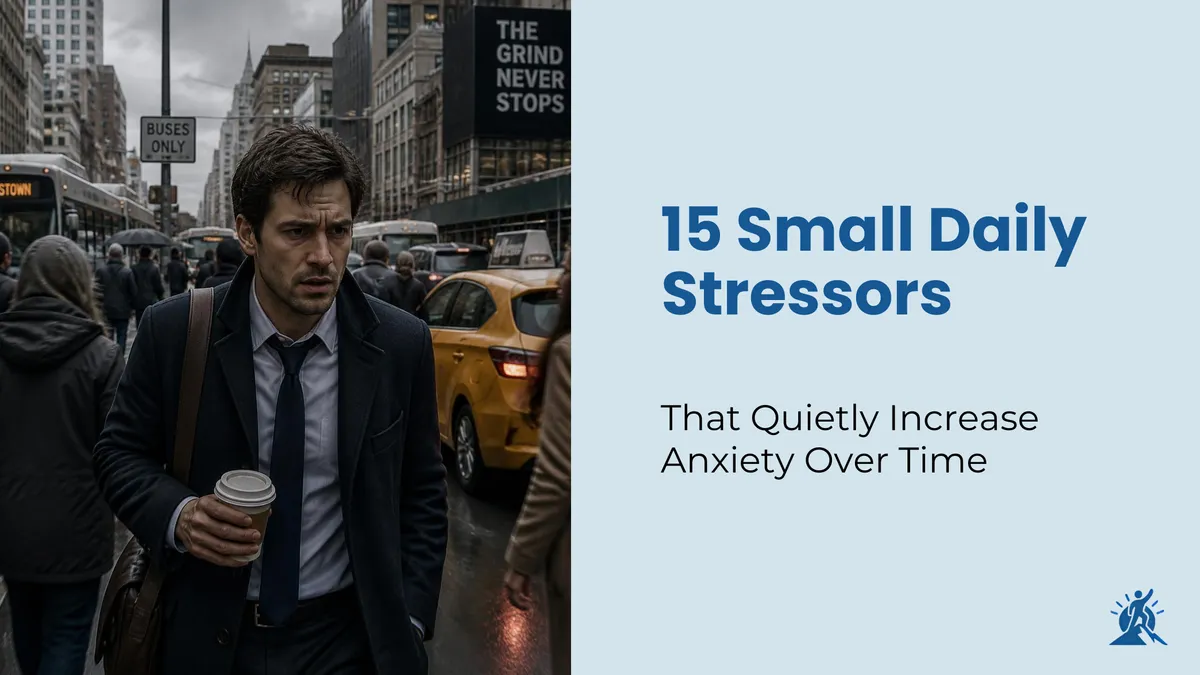
15 Small Daily Stressors That Quietly Increase Anxiety Over Time
15 Small Daily Stressors That Quietly Fuel Anxiety
Introduction
Nothing "big" has happened. No major crisis, no dramatic life event, nothing you could point to and say, "that's why I feel this way." And yet the anxiety is there anyway — a background hum that's been building for weeks, made up of things that each, on their own, seems far too small to matter.
The lost keys. The slow Wi-Fi. The unanswered email you keep meaning to send. The traffic. The dishes in the sink. None of these individually explains how you feel — but psychological research suggests that's actually the point. Decades of research on what we can call "daily hassles" has found that these small, recurring irritations often predict psychological distress better than major life events do, especially because of how relentlessly they accumulate.
In this article, we'll look at 15 small daily stressors with a genuine research basis for their impact, why minor hassles can matter more than they seem to, and practical, evidence-based ways to interrupt their accumulation before they quietly shape your baseline anxiety level.
Why Small Stressors Matter More Than They Seem To
It's tempting to dismiss minor daily irritations as too small to be "real" stress, especially compared with major life events like a job loss or relationship breakdown. But this assumption doesn't hold up well against the research. In a landmark study, psychologist Richard Lazarus and colleagues developed the Hassles and Uplifts Scale to systematically measure everyday minor stressors, and found that the frequency of daily hassles was a better predictor of concurrent and subsequent psychological symptoms than major life events scores — and this relationship held even after accounting for the effect of major life events.
Later research has consistently supported this finding. Hassle frequency may be a more effective predictor of current psychological symptoms than major life event metrics, and daily hassles have even been found to mediate the effect of major life events on depressive symptoms — meaning big events often affect mental health partly through the accumulation of related daily hassles they generate, rather than through their scale alone.
There is a physiological explanation for why this accumulation matters. According to the concept of allostatic load, developed by neuroscientist Bruce McEwen, repeated activation of the body's stress response systems — even by relatively minor stressors — produces a cumulative physiological wear that builds over time. Unlike a single major event, which tends to fade in its acute impact over months, daily hassles don't fade in the same way: they reset each morning, meaning the body may not get a full chance to recover before the next round begins.
The 15 Daily Stressors
These fall roughly into the categories Lazarus and colleagues identified in their original research — work, family, social activities, environment, practical considerations, finances, and health — each contributing to the same underlying accumulation.
Losing or misplacing things. A recurring source of minor frustration that interrupts your day and adds a small burst of stress before you've even properly started it.
An overflowing inbox. The persistent, unresolved sense of "behind" that email volume can create, even without any single message being urgent.
Slow technology or connectivity issues. Small delays and glitches that compound quietly across a workday.
Traffic or a difficult commute. One of the original hassles studied by Kanner and colleagues, and a strong example of how the same event can affect people differently depending on how they appraise it.
Minor financial concerns. Concerns about bills, credit, or budgeting that don't rise to crisis level but linger in the background.
Household chores and clutter. Ongoing, never-quite-finished tasks that contribute a low but steady stream of unresolved obligation.
Interruptions during focused work. Each interruption is minor individually, but their accumulation disrupts concentration and adds friction to completing tasks.
Small social friction. Minor disagreements, awkward exchanges, or unreturned messages that don't escalate but still register as a low-grade concern.
Decision fatigue from small daily choices. What to eat, wear, or prioritise — the sheer volume of minor decisions in a day can itself be depleting.
Noise or environmental disruption. Persistent background noise, uncomfortable temperatures, or a cluttered environment, each a minor irritant that compounds with exposure.
Time pressure and running late. Even minor lateness activates a disproportionate stress response for many people, given its social and practical implications.
Health-related niggles. Minor aches, poor sleep, or general low energy — physical hassles that fall squarely within the health category Lazarus and colleagues identified as a significant source of daily stress.
Uncertainty about a minor upcoming task. A small unresolved "to-do" that hasn't been dealt with can occupy background mental space disproportionate to its actual size.
Interpersonal caretaking demands. Small, repeated requests for help or attention from family members or colleagues, none major individually, but cumulative in effect.
Feeling unproductive or behind. A pervasive, low-grade sense of not having accomplished enough in a day — often driven more by the accumulation of the other 14 hassles than by an actual mismatch in workload.
Why This Matters If Left Unaddressed
The accumulation of daily hassles isn't just an unpleasant background hum — it has documented consequences. Kanner and colleagues' original research found that participants who reported the most daily hassles also showed more psychological symptoms of stress, including depression and anxiety, along with a documented correlation between hassle frequency and physical ill health. This pattern has been described using two related mechanisms: accumulation, where minor daily stressors build into persistent frustration and overload that develops into more serious anxiety or depression, and amplification, where the accumulated burden makes a person more reactive to subsequent, even smaller stressors.
There's also an important individual difference worth noting: people higher in a trait called neuroticism tend to show stronger emotional reactivity to daily stressors and slower recovery from them, meaning the same objective hassle can produce a larger and more prolonged physiological response — not a character flaw, but a measurable difference in how the nervous system processes these everyday signals.
Left unaddressed over months or years, this accumulated "stress debt" has been linked to long-term health outcomes, including cardiovascular disease, at a level of reliability comparable to major life events like divorce or job loss — a genuinely important finding, given how easy these small stressors are to dismiss individually.
Practical, Evidence-Based Ways to Interrupt the Accumulation
Because appraisal — how you interpret a stressor — plays such a central role in the daily hassles model, some of the most effective interventions target how you relate to these small stressors, not just the stressors themselves.
1. Notice the Accumulation, Not Just Individual Hassles
Because no single hassle typically feels significant, it's easy to miss the cumulative pattern entirely. Try this: At the end of a day that felt "off" without an obvious cause, jot down three or four small frictions you experienced — often, naming the pattern itself is clarifying.
2. Build in Genuine Recovery Windows
Since daily hassles reset each morning without necessarily allowing a full physiological recovery, deliberately building brief recovery periods into your day — rather than only recovering on weekends or holidays — can help prevent the accumulation from compounding unchecked.
Try this: A few minutes of genuinely unstructured downtime between tasks, rather than filling every gap with another small obligation, gives your stress-response system a chance to settle before the next hassle arrives.
3. Actively Notice "Uplifts," Not Just Hassles
Lazarus and colleagues' original research measured uplifts — small positive experiences — alongside hassles, and found they were meaningfully related to positive affect. Deliberately noticing small positive moments (not to cancel out the hassles, but as a genuine counterbalance) has a real basis in this research tradition.
Try this: At the end of the day, note one small uplift alongside any hassles you name — a good coffee, a kind interaction, a task actually finished.
4. Reappraise Where You Can
Because two people can have very different physiological stress responses to the exact same hassle depending on how they interpret it, it's worth noticing when a small stressor is being appraised as more threatening or significant than the situation actually calls for.
Try this: For a recurring hassle (a difficult commute, a cluttered inbox), ask whether there's a more neutral or manageable way to frame it, even if the situation itself doesn't change immediately.
5. Address the Hassles You Can Actually Resolve
Some daily hassles are genuinely fixable with a small, one-off effort (a disorganised drawer, an unanswered email, a minor task you've been avoiding). Resolving even a few of the more addressable hassles can meaningfully reduce the total accumulated load, even without eliminating every source of daily friction.
Key Takeaways
Small daily stressors — daily hassles — are consistently found to predict psychological symptoms at least as reliably as major life events, largely because of how frequently they recur.
The accumulation of minor stress builds real, measurable physiological wear over time, a concept known as allostatic load.
How you appraise a stressor genuinely changes its physiological impact, which is part of why the same hassle affects different people differently.
Noticing the pattern, building in recovery windows, and actively resolving addressable hassles are all evidence-informed ways to reduce this accumulated load.
Practical Action Steps
At the end of each day this week, jot down three or four small hassles you noticed, along with one uplift.
Build one short, genuinely unstructured recovery window into your day, rather than filling every gap with another task.
Pick one recurring, addressable hassle (a cluttered space, an overdue email) and resolve it this week to reduce your total accumulated load.
Notice one hassle you tend to appraise as more significant than it objectively is, and try reframing it more neutrally.
If a persistent, low-grade anxiety has been building without an obvious major cause, consider speaking with a psychologist — this pattern of accumulated daily stress is well recognised clinically, and support can help you address it directly.
Conclusion
Anxiety doesn't always come from one major life event. Often, it builds quietly through the accumulation of small, everyday stressors that seem insignificant on their own but gradually place increasing demands on your mind and body. When those pressures continue without enough time for recovery, it's understandable that anxiety can begin to feel constant—even when there's no obvious explanation for it.
The encouraging news is that these patterns can change. By learning to recognise the daily habits, responsibilities, and stressors that contribute to your emotional load, you can begin to make small adjustments that support your wellbeing. Progress rarely happens overnight, but even modest, consistent changes can help reduce stress and create a greater sense of balance over time.
You don't need to eliminate every source of pressure to feel better. What matters is building the skills to notice stress as it accumulates and responding to it before it becomes overwhelming. Your anxiety doesn't need a dramatic cause to be real—and taking steps to support your mental health is always worthwhile.
Reduce Stress Before It Builds Up
Whether you're dealing with persistent anxiety, emotional exhaustion, or the hidden effects of everyday stress, Recover Mental Health can help you build practical strategies that fit into real life—one small step at a time.
Developed from more than 40 years of clinical experience, RECOVER provides a comprehensive range of practical, professional, evidence-based mental health resources, including guided relaxation, self-assessments, mood tracking, educational masterclasses, and proven strategies to support your emotional wellbeing.
Best of all, RECOVER is one of the most affordable mental health apps available today, making high-quality psychological support accessible for the cost of a cup of coffee a month!
Take the first step towards a healthier, calmer mind. Subscribe to RECOVER Mental Health today and put professional support in the palm of your hand.
RECOVER can be downloaded from Apple Store or Google Play Store by searching for Recover Mental Health or via the RECOVER website.